Meaning of the 'Ouroboros' symbol
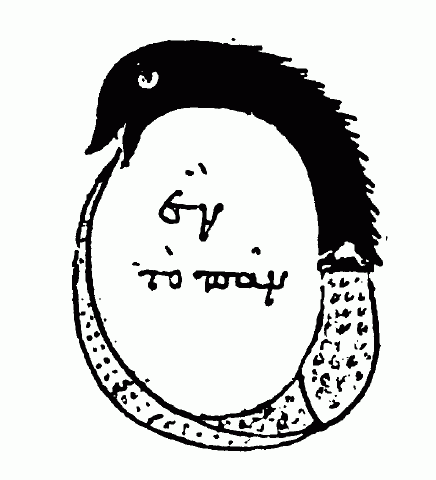
Ouroboros:
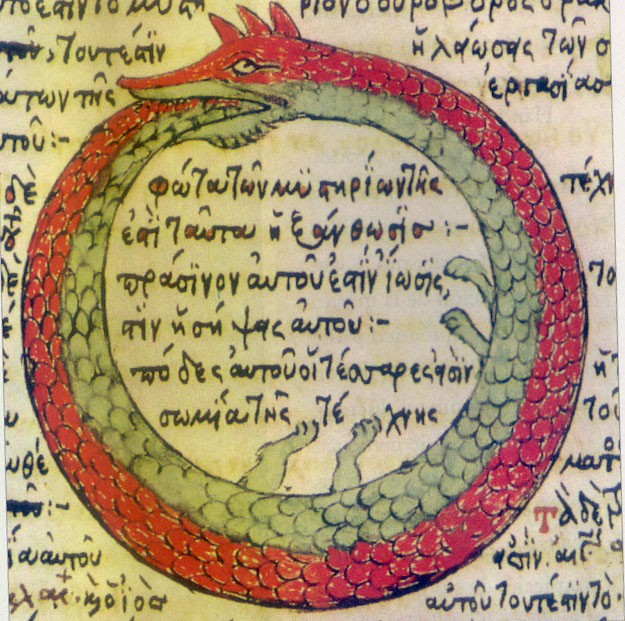
The ouroboros is a symbol that depicts a serpent or dragon swallowing its own tail, creating a circular shape. It is derived from the Greek words “oura” (tail) and “boros” (eating), meaning “tail-devourer.” The symbol has been depicted in various cultures throughout history and is often associated with cyclicality, eternity, and the concept of a continuous cycle of life, death, and rebirth. It represents the idea of self-sufficiency, self-reflexivity, and the unity of opposites.
The ouroboros can be interpreted in different ways, including as a symbol of the eternal return or the cyclical nature of the universe. It can also represent the integration of opposites, such as creation and destruction, or the idea that beginnings and endings are interconnected and part of the same process. In some mystical and alchemical traditions, the ouroboros symbolizes the union of the conscious and unconscious aspects of the self or the completion of a spiritual journey.
Hen to Pan
“Hen to pan” is a Greek phrase that can be translated as “one is the all” or “the one and the all.” It stems from the philosophical teachings of Heraclitus, an ancient Greek philosopher known for his ideas about change and flux. Heraclitus believed that reality is in a constant state of flux and that everything is interconnected.
The phrase “hen to pan” expresses the idea that there is an underlying unity or oneness that permeates all things. It suggests that the diversity and multiplicity of the world are ultimately grounded in a fundamental unity. It is often used to convey the concept that everything is interconnected and part of a larger whole.
In a broader sense, “hen to pan” can also be interpreted as a reminder of the interconnectedness of individuals, societies, and the natural world. It highlights the idea that our actions and choices have consequences that reverberate throughout the interconnected web of existence.